Thursday, March 31, 2016

Endocentric and Exocentric Compound Nouns

Most English compound nouns are endocentric. This means that the central meaning of the compound is carried by the head. The head of English compounds is on the right. In some cases, though, the central meaning isn't carried by the head. Such compounds are called exocentric.

The English compounds newspaper, textbook, classroom, handbag and bookstore are examples of endocentric compounds. The central meaning of each one is carried by the second word of the compound. For example, a newspaper is a kind of paper and a textbook is a kind of book. These compounds are hyponyms of their heads.

With exocentric compounds, however, the central meaning of the compound isn't conveyed by the head. The meaning is external to the literal meaning of the compound. Examples of exocentric compounds include scarecrow, redhead, pickpocket, showoff and paperback. They're called exocentric because a scarecrow isn't a kind of crow and a redhead isn't a kind of head. A scarecrow is an object designed to scare not only crows but all birds, a redhead is a person with red hair, a pickpocket is a person who steals from people's pockets, a showoff is a person who shows off, and a paperback is a book which is paper-bound. Notice that the word showoff doesn't contain a noun but rather a verb and a particle. When the words show and off are written separately, it's actually a verb.

Though compound nouns are usually endocentric, a large number are exocentric. With exocentric compounds, the central meaning isn't carried by the head but is external to the compound. Compound nouns usually consist of at least one noun, but not always. The compound showoff is an example of a compound noun which has no noun. Many phrasal verbs can also function as compound nouns such as takeout, pickup, breakup, breakdown and takeoff.


Sunday, March 27, 2016

Solving Problems

The brain has trouble with certain types of calculations, but not with ones that involve social issues. The reason is that the brain isn't so familiar with the rules of conditional logic, but it's good with social issues.

Imagine that you were shown four cards with the following numbers and colours: 7, BROWN, 10, BLUE. Here is a claim: If a card has an even number on one side, it has the name of a primary colour on the opposite side. Which two cards do you need to turn over to assess whether or not this is the truth?

For many people this is a difficult problem. The answer is that we need to turn over the number 10 card and the brown card. If we turned over the number 7 card and found blue on the other side, it would say nothing about the truth of the rule. This is because the statement only concerns even-numbered cards. Likewise, if we turned over the blue card and found an odd-numbered card on the other side, it would make no difference to the logical rule because it never specified what odd numbers may have on the other side.

But if we present the same problem with a social issue, it's solved easily. Suppose this is the rule: If you're under 18, you can't drink alcohol. Now each card has the age of one person on one side and the drink the person is holding on the other: RUM, 35, COKE, 16. Which cards do we need to turn over to see if the rule is being broken? Here most participants get the answer right. We need to turn over RUM and 16. The two problems are equivalent, but this one is easier to solve. People of any age can drink coke, but only those 18 and over can drink rum. People who are 35 can drink coke and rum, but those who are 16 can only drink coke.

The brain cares so much about social interaction that it has evolved special programs devoted to it. When a problem concerns a social issue such as the legal drinking age, participants can solve a logical problem easily. This is not true when the issue concerns number and colour. It appears that the brain is better conditioned to solve problems of social interaction than equivalent problems without social interaction.

Similarity in Classification

Classification and sequencing of data is often done on the basis of similarity. This isn't always the case. In the case of alphabetical order and numerical order, letter and number override similarity. However, similarity is a popular tool for classification.

Take the example of sports. They can be placed into a number of categories. These include ball sports, aquatic sports, winter sports and team sports. In certain cases, the boundary between one and the other isn't so clear. For example, tennis can be classified as a team sport (doubles, mixed doubles) but can also be classified as a ball sport. Waterpolo can be classified as an aquatic sport or as a ball sport.

Sometimes sequences vary for the same data. If we are asked to sequence white, grey and black, we may go from lightest to darkest (white, grey, black) or from darkest to lightest (black, grey, white). Both orders are equally possible. However, if we have to group hair, it's likely that we'll start with black hair and then add grey hair and white hair. The reason is that black hair is associated with young age and white hair with old age.

The sequencing changes, though, if we have to sequence clouds. It's likely that in this case we'll start with white clouds and then continue with grey clouds and black clouds. The reason is that grey and black clouds are associated with rain and black clouds are considered the ones which are most likely to be a significant source of rain.

Data can be classified and sequenced in a number of ways. Sometimes the boundary between one category and another isn't so clear. It's also true that data is sometimes classified and sequenced differently depending on the method of classification used.


Tuesday, March 22, 2016

Information Questions and Suggestions

Information questions and suggestions often have the same form, but they serve different functions. Suggestions that are formed as questions can be analyzed as indirect speech acts. This is not the case with information questions.

Consider the question "Why don't you eat meat?" One interpretation is that the hearer is a vegetarian, and the speaker wants to know the reason for this dietary choice. However, another interpretation is that of a suggestion, an indirect speech act. The speaker may be advising the hearer to eat meat. Here's a possible context. "You know, it's important to get more protein in your diet. Why don't you eat meat?" In this particular context, it's clear that the speaker isn't asking an information question but rather making a suggestion.

The question "Why don't you eat meat?" is ambiguous. It can be either an information question or a suggestion. Both interpretations are possible. If we change the question to "Why not eat meat?" only one interpretation is possible. Here we have a suggestion. This can't be interpreted as an information question.

Though information questions and suggestions often look the same, they serve different purposes. Suggestions are indirect speech acts and not genuine questions of information. If we change the auxiliary from don't or doesn't to not, there's no ambiguity. Then we must interpret the question as a suggestion.

Wednesday, March 2, 2016

Musical Notation

Modern musical notation has its origins in European classical music and is now used throughout the world. This modern style of notation uses a five-line staff. Pitch is indicated by the placement of notes on the staff.

The staff at the top is known as the treble clef and is for notes played on the right hand. The staff at the bottom is known as the base clef and is for notes played on the left hand. On the first line of the treble clef is E followed by the notes G, B, D and F. Notes with a pitch outside of the staff can be represented by ledger lines.

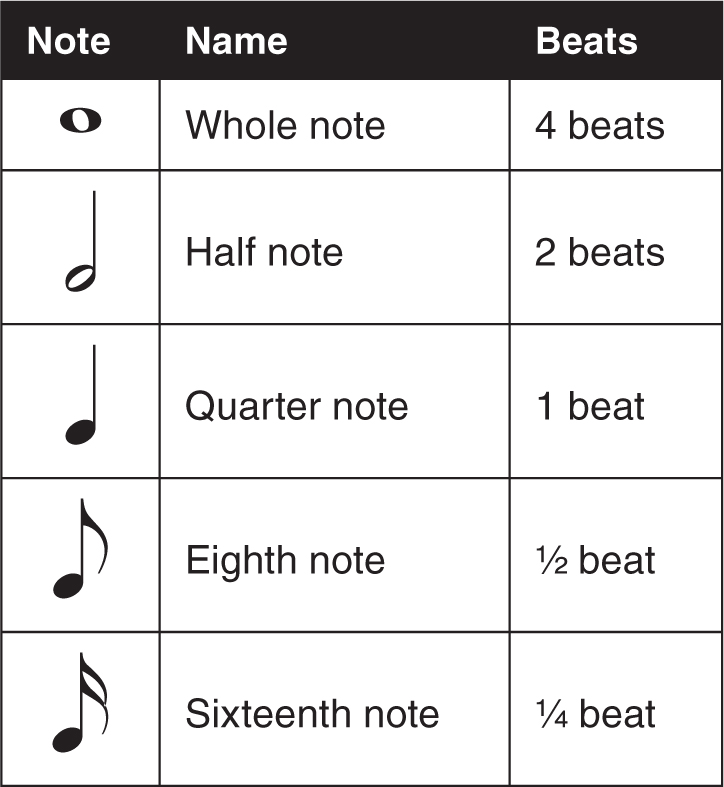
Note duration is an important element of musical notation. The duration of notes is illustrated here:

Dotted notes are also used in musical notation. A dotted note is a note which has a small dot written after it. The first dot increases the value of the original note by half. With every additional dot, the value is progressively halved. For example, a note with one dot has a value of 1.5, a note with two notes 1.75 and a note with three dotes 1.875.

Guido of Arezzo, an Italian of the medieval era, is considered the inventor of modern musical notation. His staff notation replaced an earlier form of notation known as neumatic. Unlike staff notation, neumatic was written on only four lines. Guido of Arezzo was a Benedictine monk who created the most popular system of musical notation in use today.


Wednesday, February 3, 2016

A Little Bird

Alexander Pushkin wrote plays, novels and poems. One of his poems is A Little Bird. Here is a translation:

A Little Bird

In alien lands I keep the body
Of ancient native rites and things.
I gladly free a little birdie
At celebration of the spring.

I'm now free for consolation
And thankful to almighty Lord:
At least, to one of his creations
I've given freedom in this world!

In this poem we learn that the narrator follows ancient traditions when abroad. To celebrate spring, the narrator releases a little bird, a symbol of spring, into the wild. The narrator feels sad over the loss of the bird, but also feels thankful. The reason is that the little bird, one of the smallest of God's creations, has now been given freedom.

The poem A Little Bird speaks of traditions, a little bird and spring. The narrator takes delight in giving freedom to a little bird, one of the world's smallest creations. This is done in spring, a season which marks a season of rebirth and revitilization for not only plants and flowers, but also for a little bird.

Thursday, January 14, 2016

Golden Mean

Aristotle referred to the desirable medium between two extremes as the golden mean. He explained that the golden mean of two opposite vices was a virtue. This mirrors the view that extremes are never good and that it's always best to do everything in moderation.

For example, we can say that both wastefulness and stinginess are two extreme vices. Wastefulness can be defined as the misuse or overuse of money and goods, and stinginess can be defined as a lack of spending and charity. The happy medium of the two is thus generosity. This is a virtue which is found between the two vices of wastefulness and stinginess.

Another example is the vices of pride and fear. Pride can be defined as an inflated ego or a lack of humility. However, fear can be defined as a lack of self-esteem or belief in one's own abilites. The desirable medium of these two vices is confidence. This is a virtue which can be placed between the two extremes.

The problem with this view of the golden mean is that it is not always easy to determine exactly where the desirable medium lies. What one considers confidence another may consider pride, and what may be considered a vice, i.e., fear, may actually be appropriate in situations where caution is advisable. Though not all philosophers agree that the desirable medium between two opposite vices is always a virtue, the philosophical view of the golden mean is a concept that has its origins in the teachings of Aristotle.

Featured Post

Finding the Proto-Form

Related languages have a number of words which are similar to one another. In the branch of linguistics known as historical linguistics, the...