Friday, August 6, 2021

Vowel Quality

Two features of vowel quality that are used to contrast one vowel with another are height and backness. The vowel of he is high front, and the vowel of to is high back. In the word cat, the vowel is low front. However, other features can also be used to contrast vowel quality.

Four other features are rhotacization, rounding, ATR and nasalization. Height, backness and rhotacization reflect auditory properties, and the other three reflect articulatory properties with acoustic properties that differ from vowel to vowel.

Lip rounding tends to lower the second formant, but in the case of high front vowels it is primarily the third formant that is lowered. ATR and nasalization affect different formants in different vowels. The vowel of red is a mid front unrounded lax vowel. However, instead of the term lax, the term -ATR can also be used. The quality of height precedes the qualities of backness, rounding and ATR. The term ATR means advanced tongue root. The vowel of seat is +ATR, and the vowel of sit is -ATR.

Rhotacization is found in rhotic vowels of English. The word bird has a rhotic vowel in most varieties of American English, but a non-rhotic vowel in most varieties of British English. English has vowels that are ATR and -ATR, but many languages, i.e. Spanish, do not. English has nasalized vowels such as the vowel of sand, but the vowel is not fully nasalized because the nasal is also articulated. However, in languages such as French, vowels are often fully nasalized. The French word vin (wine) has a fully nasalized vowel. The nasal segment is thus not articulated.

Vowel quality is an important feature of vowels. The two features that are most associated with vowel quality are height and backness. In the articulatory description of vowels, height is given before backness and rounding.

Saturday, July 24, 2021

Spanish Stressed and Unstressed Personal Object Pronouns

Spanish has two sets of personal object pronouns. They are stressed and unstressed. This distinction is connected to sentence stress. Though both words are stressed in isolation, the one which occurs at the end of the sentence is stressed. 

In English the object pronoun me occurs in the sentences My brother helped me and The present is for me. The position of the object pronoun is the same in English. It occurs at the end of the sentence.

However, in Spanish the sentences are Mi hermano me ayudó and El regalo es para mí. The words me and both mean me. The difference is that the first one is unstressed and the second is stressed. The unstressed pronoun occurs before the main verb and the stressed pronoun after the preposition.

Here are further examples of stressed and unstressed pronouns in Spanish:

Mi hermana te conoció. (My sister met you)
La pregunta es para ti. (The question is for you)

Mi primo la conoce. (My cousin knows her)
Su hermana va con ella. (Her brother is going with her)

Mi amigo lo conoce. (My friend knows him)
Su hermana está con él. (His sister is with him)

La película nos impresionó. (The movie impressed us)
Mis amigos están con nosotros. (My friends are with us)

Mis amigos los hicieron. (My friends made them)
La fiesta es para ellos. (The party is for them)

The stressed object pronouns ella, él, nosotros and ellos are also subject pronouns. Unlike English, Spanish has two sets of personal object pronouns. They occur in different positions in the sentence.


Friday, July 16, 2021

Differences in French and Spanish Syntax

French and Spanish share many similarities. They can be observed in vocabulary, grammar and syntax. However, the rules of French and Spanish syntax are not identical. Let us look at a few examples.

In Spanish negation is expressed with no before the verb phrase. The sentence Mi hijo no patina bien means My son doesn't skate well. The same sentence in French is Mon fils ne patine pas bien. French uses ne and pas to negate the verb phrase. However, in spoken French, the word ne is often dropped.

The sentence Ma soeur veut me voir means My sister wants to see me. French places the object pronoun before the infinitive. In Spanish, however, this sentence can be expressed in two ways. They are Mi hermana me quiere ver and Mi hermana quiere verme. The object pronoun can come before the main verb or after the infinitive. When it comes after the infinitive, it functions as a suffix. Both sentences are possible, but placing the object pronoun after the infinitive is considered more formal.

Another difference can be observed in the position of the subject. For example, the sentence My cousin is here is Mon cousin est ici in French. The word order is the same as in English. In Spanish, however, two sentences are possible. They are Mi primo está aquí and Está aquí mi primo. The subject can be placed at the beginning or the end of the sentence. The normal word order is at the beginning of the sentence, but to give more emphasis to the subject, it can also be placed at the end.

Though Spanish and French are related languages, they also differ in many respects. One of the big differences between them is in pronunciation. However, they also differ in their rules of syntax. French places the direct object pronoun before the infinitive, but Spanish places it before the main verb or after the infinitive.


Monday, July 12, 2021

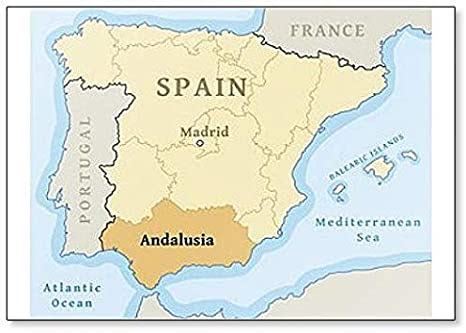
Coda Deletion in Andalusian Spanish

Andalusian Spanish is well-known for the aspiration and also deletion of word-final /s/. This process also applies syllable-finally. However, Andalusian Spanish also deletes other coda consonants.

Word-final nasals are often dropped with nasalization of the preceding vowel. In infinitives, word-final /r/ is often dropped. In certain cases, regressive assimilation occurs and the /r/ is deleted with lengthening of the following consonant. This often occurs in words such as carne (meat) in which the /r/ is deleted and the nasal is lengthened. Coda consonants can also be dropped word-internally such as in the word doctor, which results in deletion of the /k/. 

The following words have coda consonants which are often deleted in Andalusian Spanish:

arroz (rice) 
bien (well)
cantar (to sing)
ciudad (city)
escribir (to write)
luz (light)
mitad (half)
pan (bread)
razón (reason)
seis (six)

Consonant coda deletion is very common in Andalusian Spanish. Word-final deletion of the interdental fricative, i.e., ciudad (city) is in fact common in all varieties of Spanish. Andalusian Spanish is spoken in southern Spain and exhibits extensive deletion of coda consonants.


Variation in the Swedish sj-sound

The Swedish sj-sound can be pronounced with a retroflex alveolar pronunciation or with a velar one. In other words, one pronunciation is frontal and the other is dorsal. In southern Swedish, the dorsal pronunciation is common in all instances. However, in parts of Stockholm, western Sweden, northern Sweden and Finland, the frontal pronunciation is common in all instances. In Finland, the sj- sound is frontal, but it is not retroflex. Though many speakers use either the frontal or dorsal pronunciation exclusively, most Swedes use both sounds. They are used in different environments.

The dorsal sound is common before a stressed vowel. Examples include situationsju (seven) and sked (spoon). Though these words are spelt differently, the sound is the same. 

The frontal sound is common word-finally. Examples include dusch (shower), garage and prestige. It is also common in words which consist of a word-initial fricative and consonant. Examples include schlager (musical hit), schnitzel and Schweiz (Switzerland).

In certain words, both variants are common. This is the case with chans (chance) and kanske (maybe). It is often the case that speakers use the same variant for both words.

Many speakers use two pronunciations for the Swedish sj-sound. This sound can be spelled in many ways, and the two pronunciations are in complementary distribution. In certain words, i.e., chans (chance) and kanske (maybe), both pronunciations are very common.


Thursday, July 8, 2021

Types of Disjuncts

Unlike adjuncts, disjuncts do no modify structures within the sentence. They are often placed at the beginning of the sentence. Four types of disjuncts are attitude, epistemic, point of view and style.

Attitude disjuncts express an attitude towards the proposition contained in the sentence. In the utterance Luckily, he passed his exam the proposition is he passed his exam and luckily is a comment expressed by the speaker.

Style disjuncts indicate the mode in which the sentence is uttered. For example, the speaker can be honest, open, serious, etc. In the sentence Seriously, don't tell anyone, seriously is a style disjunct.

Point of view disjuncts offer a particular perspective. The sentence Politically, the event was a great success, the adverb politically indicates that from the point of view of politics, the event was very successful.

Epistemic disjuncts communicate the speaker's assessment of the probability that a proposition is true. They are usually sentence initial. An example of a sentence with an epistemic disjunct is Perhaps tomorrow will be rainy.

Disjuncts are an important part of language. Style disjuncts do not modify the sentence at all and indicate the manner in which the speaker utters the sentence. Other disjuncts include attitude, epistemic and point of view.


Tuesday, July 6, 2021

Possessive Reflexives

Possessive reflexives consist of possessives such as my, his and their. In a sentence such as Janet broke her doll, it is not clear if her refers to Janet or to another female. However, with the addition of the word own, it is no longer ambiguous. In Janet broke her own doll, her refers to Janet.

In certain cases, the possessive always refers to the subject. These structures often involve movements made with a part of the body. Here are examples:

Luke stretched his neck.
The dog wagged its tail.
The students clapped their hands.
The guest crossed her legs.
The boy bit his tongue.

Structures with possessive reflexes can be ambiguous. However, this is often not the case with parts of the body. In sentences such as The dog wagged its tail, the possessive can only refer to the subject.


Featured Post

Finding the Proto-Form

Related languages have a number of words which are similar to one another. In the branch of linguistics known as historical linguistics, the...